2026-09-25
Dark Circles: When Lower Blepharoplasty Is (and Isn't) the Answer
Discover whether lower blepharoplasty or fat repositioning is right for your dark circles. Understand causes, indications, surgical techniques, and postoperative care.

Dark circles under the eyes are rarely caused by a single factor. If bulging under-eye fat and the hollow groove beneath it cast a shadow, lower blepharoplasty or under-eye fat repositioning can be considered. Conversely, if darkness stems from skin pigmentation or visible underlying blood vessels, fat repositioning alone may not yield sufficient improvement.

This is the consultation room at Seorae Plastic Surgery. Every person's under-eye condition is unique, which is why we evaluate your anatomy thoroughly before deciding on a treatment plan.
What Is Lower Blepharoplasty?
Lower blepharoplasty is a surgical procedure designed to correct age-related changes in the lower eyelid, such as skin laxity, protruding fat pads, and prominent wrinkles or uneven contours. If skin elasticity remains good with minimal excess skin, an incision through the inner conjunctival membrane is used, leaving no external visible scar. When loose skin is present, a fine incision along the lower lash line allows for skin redraping and trimming. At Seorae Plastic Surgery, the surgical approach is determined after assessing lower eyelid tone, skin redundancy, fat volume, and the extent of hollowing.
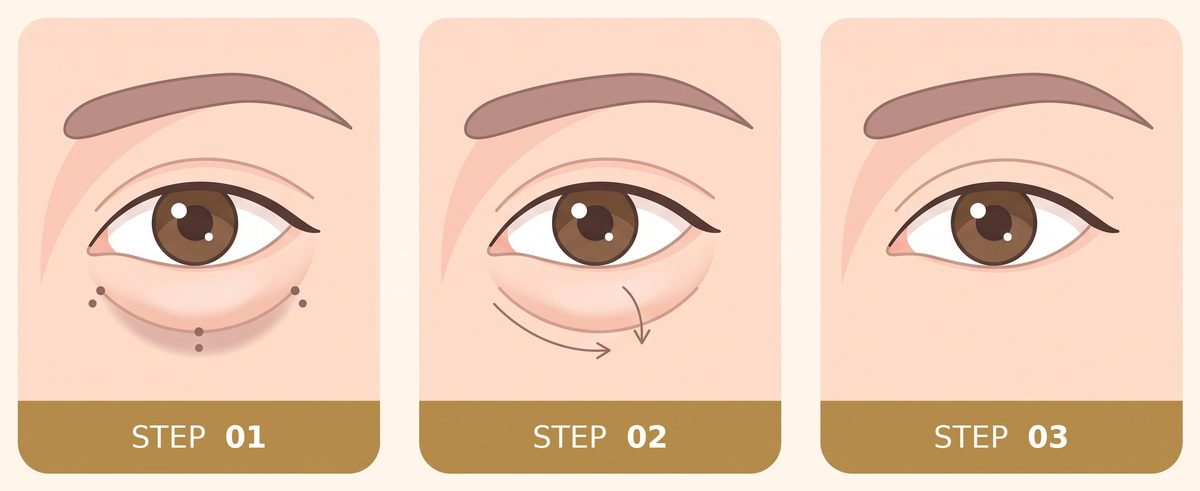
This is a conceptual illustration demonstrating the surgical steps. It does not depict actual clinical footage or patient photographs.
Who Is a Good Candidate for Lower Blepharoplasty?
Expected outcomes vary based on individual under-eye characteristics:
· Bulging, puffy under-eye fat creating shadows — Smoothing the protrusion creates a flatter, continuous contour. A study tracking 913 East Asian patients over an average of 14 months showed an overall success rate of 97.81%, defined as patient satisfaction without reoperation.
· Tear trough depression giving a tired, shadowed look — Filling the sunken hollow softens under-eye shadows. A study of 232 patients reported tear trough resolution in over 85% of cases, provided there is sufficient palpable herniated fat to reposition.
· Combined puffiness and hollow grooves — The goal is to redistribute excess fat into the tear trough depression, evening out height discrepancies.
· Prior under-eye fat removal resulting in increased hollowing — If residual fat is present upon examination, secondary revision or augmentation can be evaluated.
However, under-correction of the hollow or residual fullness may occasionally require a touch-up. In the same 232-patient study, approximately 13% experienced incomplete filling of the trough. Over time, tissue laxity can also cause recurrent fullness or hollowing. A systematic review analyzing 33 clinical studies found an overall complication rate of 11.2%, which is not uncommon.
When Other Approaches Should Be Considered
· Dark pigmentary coloration or thin skin revealing vascular networks — These are not indications for fat repositioning, and alternative dermatological treatments are recommended.
· Concomitant midface/cheek descent — A combined midface lift may be considered, which typically involves longer swelling and recovery periods.
· Deep hollowing with minimal palpable orbital fat — Alternative modalities, such as autologous fat grafting, are considered.
The left side depicts fat herniation creating shadows; the right side illustrates the surgical goal. This is an artistic concept and does not depict an actual patient; outcomes vary individually.
Why Does Under-Eye Fat Protrude?
According to domestic CT imaging analyses, aging leads to bony orbit resorption and weakening of the orbital septum, the thin membrane holding back intraorbital fat. As fat herniates forward, the adjacent tear trough appears relatively deeper, accentuating dark shadows.
Potential Complications and Post-Operative Care
The following postoperative reactions or side effects may occur:
· Swelling and bruising — Common at the surgical site.
· Chemosis (conjunctival swelling) — A frequent temporary symptom, generally resolving within 3 weeks in reported clinical series.
· Dryness and foreign body sensation — Temporarily common; patients with pre-existing dry eye may experience prolonged symptoms and potential corneal surface irritation.
· Diplopia (double vision) — An uncommon, transient complication.
· Lower eyelid malposition or ectropion — May expose more sclera (white of the eye).
· Asymmetry, residual fullness, or over-resection — Can result in surface irregularities or accentuated hollows.
· Hematoma — Blood collection at the surgical site or within the eyelid tissues.
· Hypoesthesia (numbness) of the eyelid — Usually temporary and reported to resolve spontaneously over time.
· Rare but severe complications — Infections, retrobulbar hematoma, and vision compromise have been documented in rare literature cases.
Seorae Plastic Surgery's Three Core Principles:
· Dedicated Care by the Chief Surgeon — From consultation and surgery to suture removal, the board-certified head director oversees your entire care pathway.
· Strict Infection Control — Comprehensive instrument sterilization and facility disinfection protocols are strictly maintained.
· Guided Recovery Process — Care does not end on the day of surgery; healing progress is monitored closely through scheduled follow-ups.
If you have any questions, feel free to reach out anytime. Telephone: 02-547-3351. Please contact the clinic immediately if you experience unusual pain or changes in vision. Recovery timelines and surgical results vary by technique and individual condition, and complications may arise; please consult a qualified specialist during your visit for comprehensive guidance.
Important Medical History to Disclose Prior to Surgery
· History of severe dry eye syndrome or ocular surface disease — Postoperative dryness may be prolonged, and surgery may not be advised if tear production is severely compromised.
· Previous periocular or lower eyelid procedures — Including prior under-eye fat removal.
· Prominent globe projection (proptosis) or significant lower lid laxity — Associated with an increased risk of lid position changes.
· Use of anticoagulants or antiplatelet medications — Relevant to bleeding tendencies.
· Systemic and ophthalmic conditions — Thyroid disease, glaucoma, diabetes, hypertension, and smoking history will be evaluated during your consultation.
Frequently Asked Questions
Q. Will surgery completely eliminate my dark circles?
It depends on the underlying cause. If the dark appearance is due to shadowing caused by herniated fat or a sunken tear trough, surgical correction can be very effective. However, dark circles caused by dermal pigmentation or superficial vascularity require different therapies. Often multiple causes coexist, which we differentiate during clinical examination.
Q. At what age can one undergo this procedure?
Surgical indication is determined by anatomical condition rather than chronological age. In an East Asian study of 439 patients, individuals in their 20s with congenital fat protrusion and tear troughs also underwent successful procedures.
Q. Does lower blepharoplasty improve fine under-eye wrinkles?
When redundant skin is excised through a subciliary incision, resting static wrinkles can improve significantly. However, dynamic expression lines that appear when smiling cannot be eliminated by this procedure alone.
Consultation & Appointment Information
Phone Consultation / Booking | 02-547-3351To ensure meticulous patient care, our clinic operates primarily by appointment. Please contact us in advance to schedule your visit. Pricing details are provided during your consultation. |
Clinic Hours | Mon, Tue, Thu, Fri: AM 10:00 – PM 19:00 Saturday: AM 10:00 – PM 17:00 Closed — Wednesdays, Sundays, and Public Holidays |
Location | Room 413, 4th Floor, One Bailey Square, 291 Banpo-daero, Seocho-gu, Seoul Conveniently located near Sinbanpo Station. View on Naver Map |

Please call us if you have trouble finding your way. View on Google Maps
References
· Park KY, Kwon HJ, Youn CS, Seo SJ, Kim MN. Treatments of Infra-Orbital Dark Circles by Various Etiologies. Ann Dermatol. 2018;30(5):522-528. PMID 33911473.
· Michelle L, Pouldar Foulad D, Ekelem C, Saedi N, Mesinkovska NA. Treatments of Periorbital Hyperpigmentation: A Systematic Review. Dermatol Surg. 2021;47(1):70-74. PMID 32740208.
· Lee H, Ahn SM, Chang M, Park M, Baek S. Analysis of lower eyelid aging in an Asian population for customized lower eyelid blepharoplasty. J Craniofac Surg. 2014;25(2):348-51. PMID 24514885.
· Kim J, Park SW, Choi J, Jeong W, Lee S. Ageing of the bony orbit is a major cause of age-related intraorbital fat herniation. J Plast Reconstr Aesthet Surg. 2018;71(5):658-664. PMID 29273552.
· Termanini KM, Alghoul MS. Tear Trough Deformity: Update on Anatomy and Clinical Management. Aesthet Surg J. 2026;46(6):577-585. PMID 42150047.
· Liu J, Huang C, Song B. A graded approach in East Asian personalized lower blepharoplasty: A retrospective study spanning 12 years. Indian J Ophthalmol. 2022;70(8):3088-3094. PMID 35918978.
· Mao X, Zhang L, Cheng L, Sun X, Wang C, Zhang Y, Li Q, Zhang Y. Reflections on Aging Series: Multiple Factors Influencing Lower Blepharoplasty Procedure Selection in an East Asian Population. Aesthet Surg J Open Forum. 2025;7:ojaf078. PMID 40800042.
· Chen J, Wu Y, Wang Y, Zhang B, Tang J, Wang Z, Huang W, Cheng B. Transconjunctival Fat Repositioning Blepharoplasty: Is Excess Fat Herniation a Prerequisite? Plast Reconstr Surg. 2024;153(5):1039-1046. PMID 37220233.
· Xu Z, Zheng F, Zhao X, Wang S, Wang R, He J, Gan F. Complications of Fat Grafting and Repositioning for Correction of Lower Eyelid Pouch With Tear Trough Deformity or Lid-Cheek Junction: A Systematic Review. Ann Plast Surg. 2024;93(3):e9-e25. PMID 39158343.
· Taghioff SM, Munkwitz SE, Quan H, Slavin B, Garg S, Yasmeh J, Kassira WM, Thaller SR. Safety Considerations in Blepharoplasty: A Comprehensive Review. J Craniofac Surg. 2026 Aug 5. Online ahead of print. PMID 42555303.
· Lee TY, Cha JH, Ko HW. Rejuvenation of the Lower Eyelid and Midface with Deep Nasolabial Fat Lift in East Asians. Plast Reconstr Surg. 2023;151(6):931e-940e. PMID 36728624.
This article provides general medical information compiled by Seorae Plastic Surgery based on published literature and clinic practice guidelines; it does not guarantee specific clinical outcomes. Cited studies reflect findings from third-party academic institutions, not direct clinical data of Seorae Plastic Surgery. Treatment efficacy, recovery time, and potential side effects vary by individual; please consult a qualified specialist for individualized assessment.
#LowerBlepharoplasty #UnderEyeBlepharoplasty #UnderEyeFatRepositioning #UnderEyeFat #UnderEyeFatRemoval #DarkCircles #UnderEyeHollowing #UnderEyePuffiness #TearTrough #MiddleAgeBlepharoplasty #EyeSurgery #SeochoPlasticSurgery #BanpoPlasticSurgery #ExpressBusTerminalPlasticSurgery #SinbanpoStationPlasticSurgery #SeoraePlasticSurgery