2026-10-02
Sagging Jawline: What a Lower Facelift Can and Cannot Reverse
An expert overview of what a lower facelift can correct—addressing jowls, jawline laxity, and marionette lines via the SMAS layer—and where alternative treatments are needed.
A sagging jawline and jowls (sagging tissue along the jawline beside the mouth corners) are not solely skin-related issues. Here is an overview of what can be expected from a lower facelift and when other approaches may be necessary.

This is the consultation room at Seorae Plastic Surgery. Because the causes of a sagging jawline vary from person to person, we first assess your condition during consultation before deciding on the appropriate method.
What kind of surgery is a lower facelift?
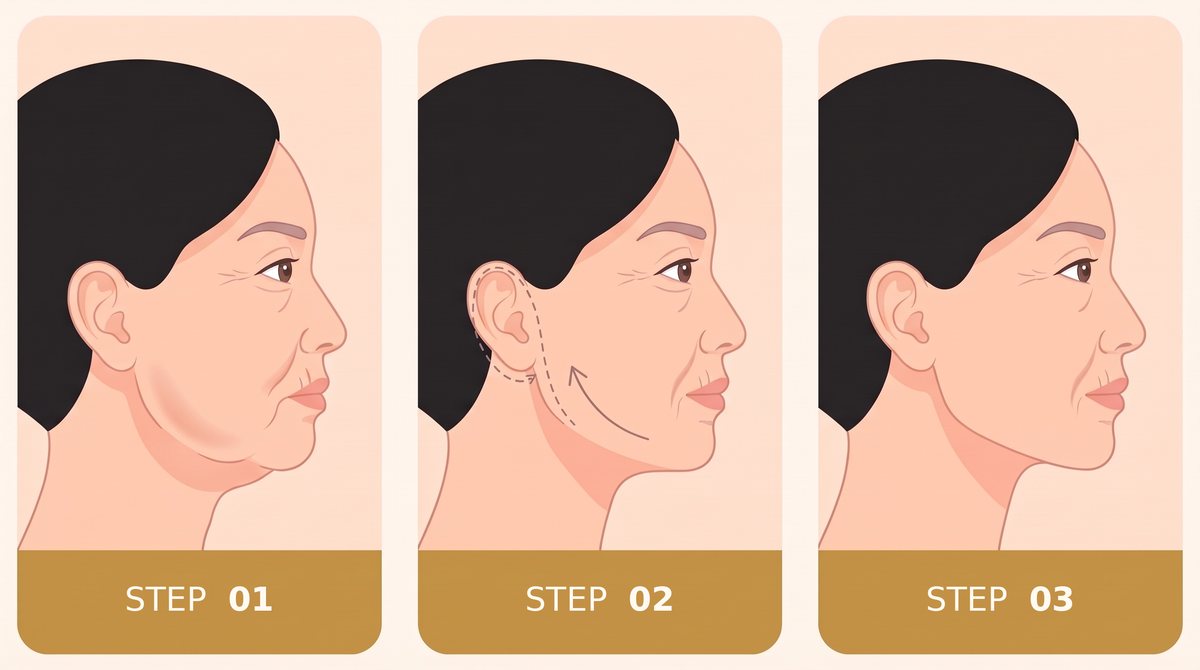
A lower facelift is a procedure designed to address laxity from the tip of the nose down to the jawline. Rather than merely pulling the skin, it also addresses the deeper fibromuscular layer (SMAS) supporting the face, aiming to refine the jowls and restore the contour of the jawline.
The reason the SMAS layer must be treated is that sagging is not just an issue of the skin surface. As aging progresses, the SMAS layer thins, the subcutaneous tissues beside the mouth corners stretch, and gravity compounds these changes, resulting in prominent jowls. These morphological changes have been observed in Japanese female CT and anatomical studies.
This is a conceptual illustration showing the surgical procedure workflow. It is not an actual operative photo or patient case. Individual results may vary.
Who is a good candidate for a lower facelift?
Noticeable improvements can typically be expected in individuals with:
· A jawline blurred by prominent jowls — The surgical correction helps restore a continuous, clean jawline contour. In a study analyzing 32 Korean patients, jawline definition was enhanced at 1 year postoperatively without widening facial width.
· Deepening creases extending from the mouth corners to the chin (marionette lines) — These lines can be significantly softened. In a clinical report of 1,000 patients from a domestic plastic surgery clinic, the average patient satisfaction rating for this area was 88.5 out of 100 at 1 year post-op.
· Laxity or fullness under the chin — Submental contours can also be streamlined alongside the jawline.
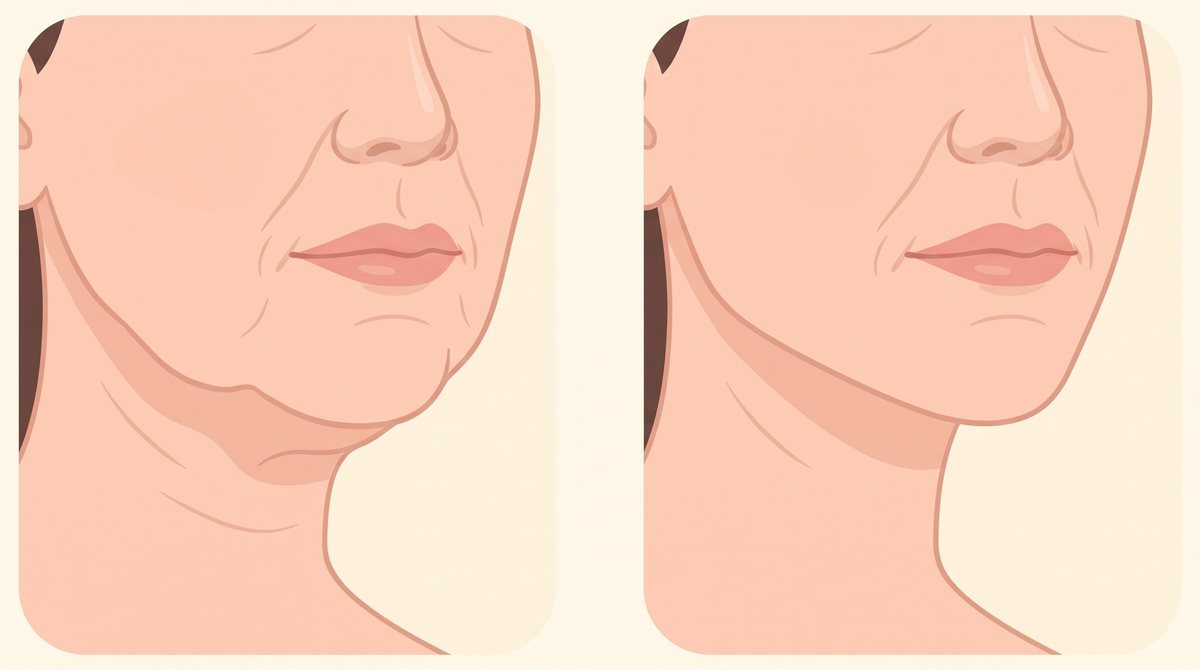
The left shows a conceptual illustration of a jawline obscured by jowls; the right illustrates the targeted surgical outcome. Fine lines around the mouth generally do not respond well to a facelift, which is why they are depicted similarly on both sides. This is not an actual patient photo, and individual results may vary.
How long do the results last?
In a UK study following 50 patients 5.5 years post-surgery, the elevation achieved in the jowl area was largely sustained (relapse rate of approximately 21%). However, the cervicomental angle (the junction between the submentum and the neck) showed a higher degree of relaxation (approximately 69%), indicating that neck tissue may loosen more quickly than the jawline. Since the aging process continues naturally, gradual tissue descent may recur over time.
Cases where combined or alternative procedures are considered
· When laxity in the nasolabial folds and anterior midface is the primary concern — Studies report that in faces with wider zygomatic arches, lateral traction does not effectively transmit to the central nasolabial folds; therefore, a concurrent midface lift may be considered.
· When neck skin laxity is pronounced — A neck lift is often performed alongside a facial lift, and this choice is made during consultation based on the degree of neck banding, horizontal creases, and jawline anatomy. Complete elimination of horizontal neck creases cannot be guaranteed.
· Perioral fine wrinkles, skin texture changes, and hollow cheeks — These do not reliably improve with a facelift alone, so minimally invasive procedures, laser resurfacing, or facial fat grafting are often recommended in combination.
The thickness of the SMAS and subcutaneous fat layer, skin elasticity, and the severity of tissue descent vary by individual. Because no single technique is universally superior, Seorae Plastic Surgery thoroughly assesses anatomical conditions first to determine the tailored surgical plan.
Potential Complications and Postoperative Care
The following postoperative reactions and side effects may occur:
· Swelling and bruising — Common and expected.
· Hematoma or surgical site infection — Relatively common surgical risks that require medical management.
· Seroma (clear fluid collection beneath the wound) — May occur.
· Temporary weakness of unilateral facial movement — May occur; permanent motor nerve damage is extremely rare.
· Decreased or altered sensation around the ear and cheek — May occur; sensation typically resolves spontaneously in most reports.
· Hypertrophic or widened scarring, alteration of earlobe contour (pixie ear) — May occur; Asian patients tend to have a higher propensity for hypertrophic scar formation.
· Delayed wound healing along incision margins, temporary alopecia (hair loss) — May occur.
· Suture reaction — May occur.
· Salivary leakage into the surgical wound — May occur rarely.
· Under-correction or unsatisfied outcome — Occurs rarely; secondary revision surgery may be warranted.
Most of these reactions and complications are reported to be temporary and manageable.
Seorae Plastic Surgery’s Three Core Principles:
· Surgeon Accountability — From the initial consultation and surgical execution to suture removal, the Medical Director oversees your care throughout.
· Infection Control — Meticulous sterilization of surgical instruments and medical environment disinfection are rigorously practiced per protocols.
· Dedicated Recovery Management — Surgery day does not mark the end of treatment. Healing progress is scheduled and evaluated at every milestone.
If you have any questions, please feel free to inquire at any time. Phone consultations: 02-547-3351. Please contact us immediately if you experience unexpected or severe pain or swelling. Recovery courses vary according to surgical methods and individual anatomy, and complications may occur; please discuss all details with your specialist surgeon during consultation.
Important Medical History to Disclose Before Surgery
· Smoking, obesity, hypertension, anticoagulant/antiplatelet medications — These are well-documented risk factors that elevate the incidence of hematoma and wound complications. Male patients or those undergoing combined procedures may also face higher risks, making pre- and postoperative blood pressure control essential.
· History of ultrasound/RF energy lifting, thread lifts, or dermal fillers — Particularly with repeated procedures, deep tissue fibrosis and scar tissue may be present, increasing surgical complexity. Please inform us of the types, target areas, and quantities of any prior interventions, especially fillers.
Frequently Asked Questions
Q. Where are the facelift scars located?
Incisions for a lower facelift are placed discretely around the natural contours of the ear. The precise placement of incisions across different anatomic regions will be thoroughly explained during your consultation.
Q. How long does the recovery period take?
Recovery duration varies depending on surgical scope, technique, and individual healing capacity. During consultation, we provide an estimated timeline for suture removal and major swelling resolution. Please inform us in advance if you have important events scheduled.
Q. Can surgery be performed at an advanced age?
Surgical candidacy is evaluated based on overall health and tissue quality rather than chronological age. In a published study of 541 patients screened for fitness before surgery, age alone—including patients aged 75 and older—did not independently increase complication rates.
Consultation & Appointment Information
Phone Consultation / Booking | 02-547-3351Our clinic operates by appointment only to ensure seamless and attentive patient care. Please contact us in advance of your visit to schedule. Exact surgical fees are provided during the in-person consultation. |
Clinic Hours | Mon, Tue, Thu, Fri: AM 10:00 – PM 19:00 Saturday: AM 10:00 – PM 17:00 Closed — Wednesdays, Sundays, and Public Holidays |
Location | #413, 4th Floor, One Bailey Square, 291 Banpo-daero, Seocho-gu, Seoul Conveniently located near Sinbanpo Station. View on Naver Map |
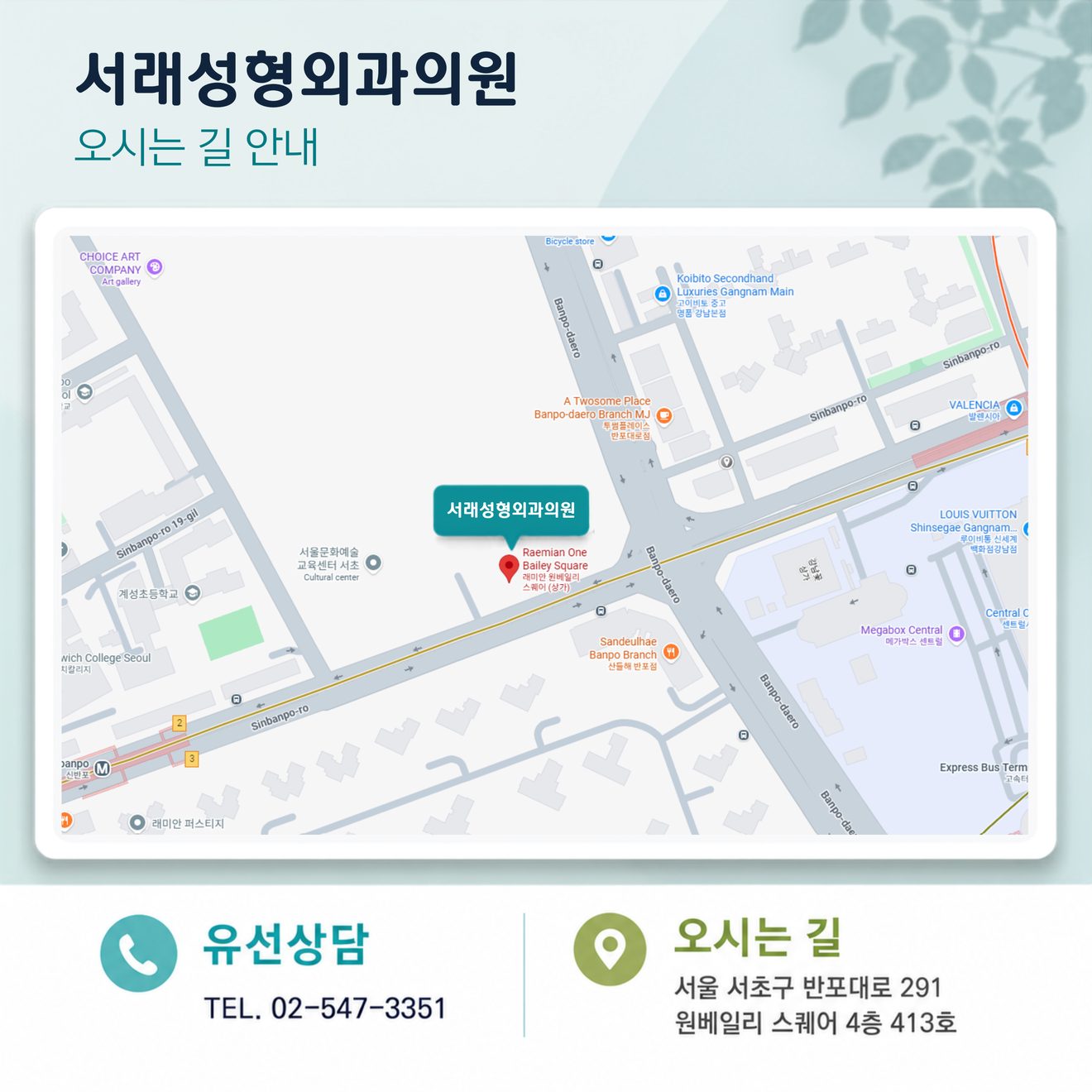
Please call us if you have difficulty finding your way. View on Google Maps
References
· Jones BM, Lo SJ. How long does a face lift last? Objective and subjective measurements over a 5-year period. Plast Reconstr Surg. 2012;130(6):1317-1327. PMID 23190814.
· Kim YC, Choi JM, Oh TS. Extended Superficial Musculoaponeurotic System Face-Lift With Vertical Vector for Asian Patients: A 3-Dimensional Analysis of Facial Contour. J Craniofac Surg. 2023;34(1):206-213. PMID 36173963.
· Kim DG, Lee SH, Bae SG. An Approach to Selection of Face-Lift Techniques for Different Types of Faces: An Analysis of 1000 Asian Patients Over 9 Years. Ann Plast Surg. 2024;93(2):153-162. PMID 38984658.
· Sommar P, Law J, Ongena J, Verpaele A, Tonnard P. Use of Ancillary Procedures in Combination with the MACS-Lift for Facial Rejuvenation: A Retrospective Cohort Study. Aesthetic Plast Surg. 2026;50(2):582-591. PMID 40906287.
· Wong CH, Hsieh MKH, Mendelson B. Deep Plane Face Lift in Asian Patients. Plast Reconstr Surg. 2025;156(4):485e-496e. PMID 40183553.
· Okuda I, Abe K, Yoshioka N, Komemushi T, Jinzaki M, Ohjimi H. Objective Analysis of Age-Related Changes in the Superficial Musculoaponeurotic System in Japanese Females Using Computed Tomography. Aesthet Surg J Open Forum. 2023;5:ojad043. PMID 37333712.
· Minelli L, Yang HM, van der Lei B, Mendelson B. The Surgical Anatomy of the Jowl and the Mandibular Ligament Reassessed. Aesthetic Plast Surg. 2023;47(1):170-180. PMID 36050569.
· Gandra G, Silva BS, Horta R. Facelift Surgery and Nerve Injury: A Systematic Review and Meta-Analysis. Aesthetic Plast Surg. 2025;49(20):5696-5711. PMID 40456989.
· Çelik M, Gürlek İÖ. Clinical evaluation of complications and the learning curve in deep plane facelift surgery: A single-surgeon experience. J Plast Reconstr Aesthet Surg. 2026;119:263-273. PMID 42385438.
· Chopan M, Samant S, Mast BA. Contemporary Analysis of Rhytidectomy Using the Tracking Operations and Outcomes for Plastic Surgeons Database with 13,346 Patients. Plast Reconstr Surg. 2020;145(6):1402-1408. PMID 32459769.
· Stewart CM, Bassiri-Tehrani B, Jones HE, Nahai F. Evidence of Hematoma Prevention After Facelift. Aesthet Surg J. 2024;44(2):134-143. PMID 37540899.
· Vishwanath N, Mandelbaum M, Williams-Medina E, Darras O, Fraiman E, Patel V, Sinclair NR, Zins JE. Effect of Age on Complications in Facelift Surgery. Aesthet Surg J. 2026;46(9):NP99-NP109. PMID 42045665.
This article provides general medical information compiled by Seorae Plastic Surgery based on published PubMed study abstracts, full texts, and clinic treatment guidelines, and does not guarantee specific clinical outcomes or diagnoses. The referenced studies reflect results from external medical institutions and do not represent Seorae Plastic Surgery's direct clinical outcomes. Surgical outcomes and recovery timelines vary by individual anatomy, and potential complications may occur. Please consult a board-certified specialist during an in-person evaluation for detailed medical advice.
#LowerFacelift #LowerFaceLift #Facelift #Rhytidectomy #JawlineLifting #SaggingJawline #Jowls #JawlineLaxity #MarionetteLines #SMASLifting #MiddleAgePlasticSurgery #SeochoPlasticSurgery #BanpoPlasticSurgery #ExpressBusTerminalPlasticSurgery #SinbanpoPlasticSurgery #SeoraePlasticSurgery