2026-10-31
Fitting vs. Ultrasound Lifting: What's the Difference?
Fitting (microwave) and ultrasound lifting heat tissue differently. A study of 171 patients found microwave less painful with earlier gains, while ultrasound improved more by 3 months.
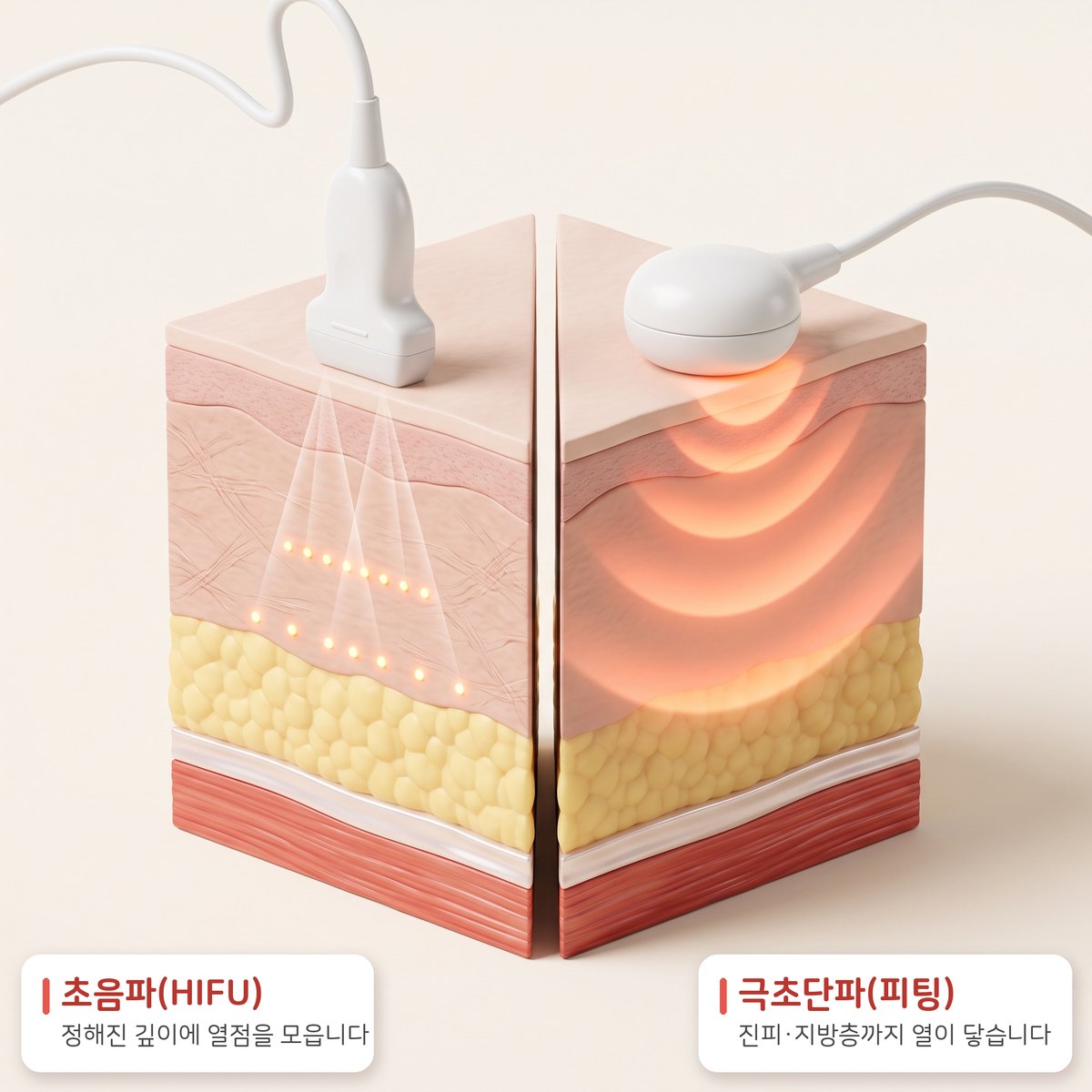
Fitting (microwave) and ultrasound lifting deliver heat in different ways. In a comparison study of devices using each method, microwave felt less painful and showed larger changes around the 1-month mark, while ultrasound showed larger changes around 3 months. Rather than deciding which is better, we choose based on the change you want during consultation.

Which device is right for you will be decided together with your doctor during your visit, after we examine your skin condition.
How do fitting and ultrasound deliver heat differently?
Ultrasound and radiofrequency are methods that deliver energy to the dermis to stimulate collagen production there. The dermis is the inner layer of skin where collagen is concentrated. Fitting shares the same goal, but it delivers heat in a different way.
This is an AI-generated conceptual diagram. Actual depths and proportions differ.
Ultrasound lifting (HIFU) works like a magnifying glass, focusing ultrasound energy at a set depth to create tiny heat zones in the deep dermis and in the membrane-like layer that supports the face.
Fitting (PTING) delivers energy to the dermis and fat layers using microwaves (UHF). Some devices that use microwaves, a type of radio wave, are designed to direct more energy toward the fat layer.
Lincurve Pro is an ultrasound device. Seorae Plastic Surgery offers both devices. You can find details about the devices in our previous post (Fitting · Lincurve Pro).
How did the two methods compare in a direct study?
One study reviewed the records of 171 East Asian patients at a single clinic who had received either a microwave device of the same type as Fitting or ultrasound lifting.
Item | Microwave method | Ultrasound lifting |
Where the heat reaches | Fat layer and dermis | Dermis and the membrane-like layer beneath it |
Pain score (lower = less pain) | 2.3 | 4.7 |
Around 1 month | Greater improvement, firmness, and satisfaction | Relatively smaller |
Around 3 months | Relatively smaller | Greater improvement, firmness, and satisfaction |
Side effects | Mild and temporary, less frequent | Mild and temporary |
Comparison of microwave-method devices and ultrasound lifting (171 patients at one clinic, 1 and 3 months)
In short, microwave felt less painful and showed changes sooner, while ultrasound showed bigger changes over time. The researchers viewed the two methods as complementary.
Which one is right for my concern?
The right method depends on the area and your goals.
If you're concerned about | Method to consider first | Changes seen in studies |
Sagging under the chin or double chin | Microwave method | Study of 10 people: after 2 treatments, submental sagging score went from 3.6 to 2.3 at 12 weeks (out of 4) |
Worried about pain and want faster results | Microwave method | Greater improvement than ultrasound around 1 month, with pain scores roughly half |
Mild to moderate sagging, and you want to lift the cheeks and jawline | Ultrasound method | Clinician assessment: about 9 in 10 people showed improved firmness and wrinkles at 90 days (mostly mild to moderate) |
Severe sagging | Consider surgical lifting as well | In ultrasound studies, results were reduced when sagging was severe or body weight was high |
Methods to consider first, by concern (the right-hand column shows studies of other devices using the same methods, not Fitting or Lincurve Pro)
In short, the deciding factor is the change you want, not which method is better.

This is an AI-generated example image and not an actual patient photo. Results vary from person to person.
Both methods are aimed at managing skin firmness rather than eliminating sagging all at once. Non-surgical approaches alone may not be enough. Depending on the cause, a different treatment may be more appropriate.
What reactions might occur after treatment?
Both methods may cause the following reactions or side effects after treatment.
· Redness, swelling, warmth — usually subsides within a few days.
· Pain during treatment — you may feel a burning or tingling pain.
· Bruising, lumps, firmness — you may bruise, or tender, firm lumps may be felt for a while. Very rarely, lumps may persist for a long time.
· Numbness or hypersensitivity — rarely, you may feel tingling or sensitivity. Very rarely, a nerve injury may affect facial movement.
· Burns, blisters, skin marks — rarely, burns, blisters, linear or raised marks, or dermatitis may occur.
· Facial hollowing — treatments that heat deeper layers may reduce fat and cause a hollowed appearance.
· Scarring or skin damage — very rarely, the skin may break down or scar, and it may become uneven or look asymmetrical.
If the treatment feels too hot or painful, please tell us right away. If blisters form after treatment, or the pain or redness gets worse, don't wait to contact us.
Guidelines for microwave devices used on the body recommend avoiding direct sunlight for about two days after treatment and avoiding hot water while redness persists. Precautions on the day of treatment differ depending on the type of treatment and area. We will also follow up on your recovery after treatment and provide guidance.
If you are considering Fitting or ultrasound lifting, what should you do now?
· Decide on one goal — come in having decided which comes first: under-chin, cheek and jawline, or faster results.
· Tell us about recent treatments — fillers or Botox in the same area may require timing adjustments, and areas with fat grafts may need to be avoided. Please also share any previous lifting history.
· Share your health status — pregnancy or breastfeeding, implanted devices such as a pacemaker, metal implants, blood-thinning medication, or inflammation or wounds in the treatment area may make treatment difficult. Please also let us know about any other medical conditions and medications you take so we can plan together.
At Seorae Plastic Surgery, our head physician personally handles everything from consultation through treatment and follow-up.
Frequently Asked Questions
Q. How long do lifting results last?
One analysis of ultrasound studies reported improvements lasting up to one year, but there is no longer-term data. Microwave facial studies are still few, and most have followed patients for only about three months, so long-term effects and safety need further confirmation. Results are not permanent after a single treatment.
Q. Is it better to get both treatments?
No study has yet compared people who received both treatments. Whether to combine them, and in what order, is decided during your visit based on your skin condition.
Consultation and Booking Information
Phone / Booking | 02-547-3351Our clinic operates by appointment to provide smoother care. Please call ahead and we will help you book your visit. Costs will be explained during your consultation. |
Hours | Mon, Tue, Thu, Fri: 10:00 AM – 7:00 PM Saturday: 10:00 AM – 5:00 PM Closed: every Wednesday, Sunday, and public holidays |
Directions | 291 Banpo-daero, Seocho-gu, Seoul, One Bailey Square, 4th Floor, Room 413 Near Sinbanpo Station. View on Naver Map |
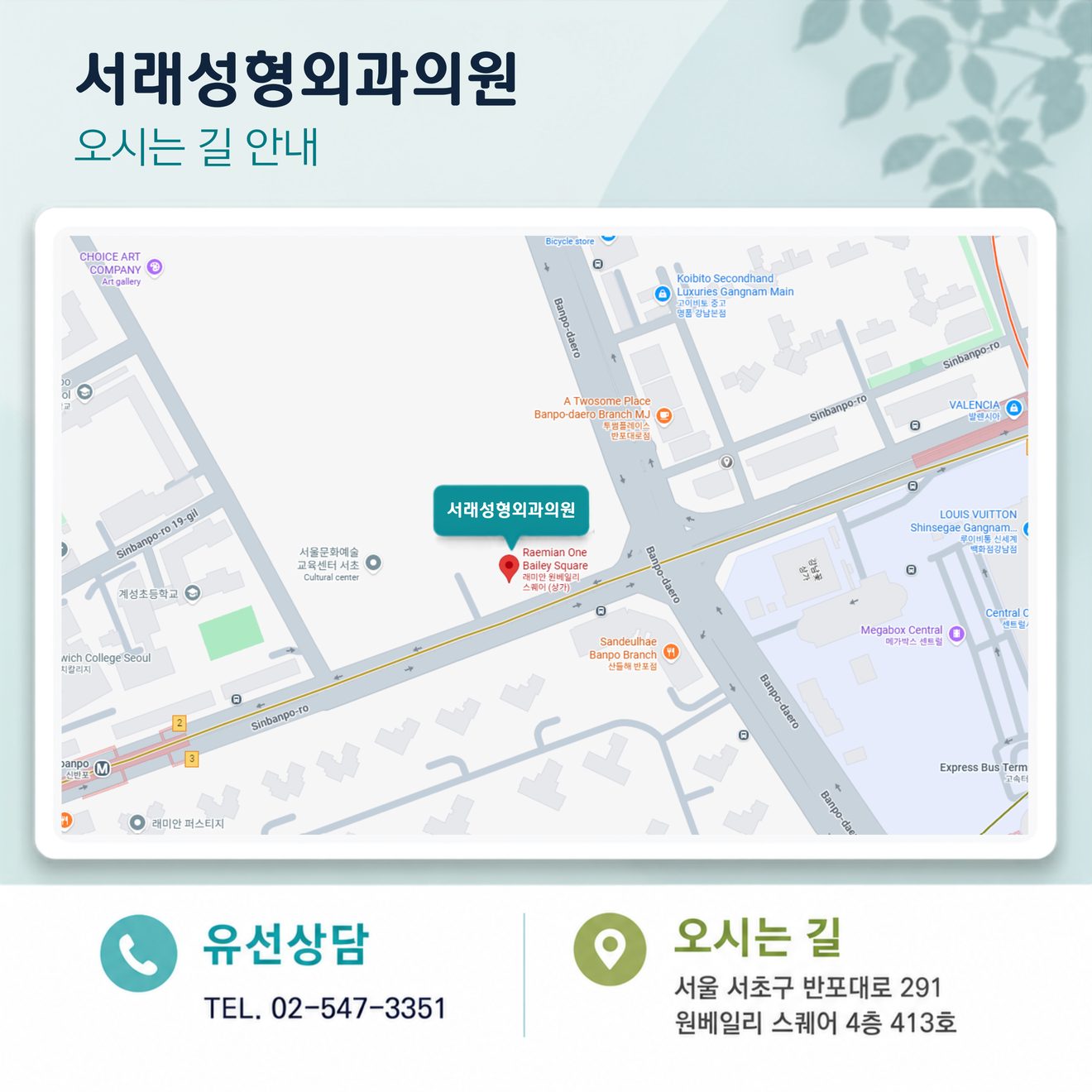
If you have trouble finding the way, please give us a call. View on Google Maps
References
· Nam HJ, Cheon N, Choi YS, Kang HY, Kim SY, Choi HJ. Efficacy and Safety of Microwave Energy-Based Device for Facial Rejuvenation: A Retrospective Comparative Study With High-Intensity Focused Ultrasound. Aesthet Surg J. 2026;46(5):543-554. PMID 41403025.
· Zappia E, Bonan P, Coli F, Del Re C, Cassalia F, Tolone M, et al. An innovative microwave technology for the treatment of submental skin laxity. Lasers Med Sci. 2025;40(1):28. PMID 39841282.
· Contini M, Hollander MHJ, Vissink A, Schepers RH, Jansma J, Schortinghuis J. A Systematic Review of the Efficacy of Microfocused Ultrasound for Facial Skin Tightening. Int J Environ Res Public Health. 2023;20(2):1522. PMID 36674277.
· Cho CH, Koo S, Yoo K. Energy-Based Devices for GLP-1 Receptor Agonist-Associated Facial Aging: A Tissue-Specific Safety Framework. Clin Cosmet Investig Dermatol. 2026;19:628537. PMID 42893183.
· Hoffmann K, Zappia E, Bonan P, Coli F, Bennardo L, Clementoni MT, et al. Microwave-Energy-Based Device for the Treatment of Cellulite and Localized Adiposity: Recommendations of the "Onda Coolwaves" International Advisory Board. Bioengineering (Basel). 2024;11(12):1249. PMID 39768067.
· Humphrey VS, Rambhia PH, Gmyrek R, Chapas A. Microfocused Ultrasound With Visualization: A Systematic Review of Adverse Events and Risk of Subsequent Facelift Compromise. Dermatol Surg. 2025;51(4):424-429. PMID 39625163.
· Friedmann DP, Bourgeois GP, Chan HHL, Zedlitz AC, Butterwick KJ. Complications from microfocused transcutaneous ultrasound: Case series and review of the literature. Lasers Surg Med. 2018;50(1):13-19. PMID 29154457.
This article is general information prepared by Seorae Plastic Surgery based on abstracts and full texts of papers indexed in PubMed, along with our in-clinic treatment guidelines. It does not guarantee any diagnosis or treatment outcome. All cited studies are from other medical institutions and are not results from Seorae Plastic Surgery. Effects and recovery times vary by individual condition, and side effects may occur. For details, please consult a specialist during your visit.
#Fitting #FittingLifting #PTING #MicrowaveLifting #UltrasoundLifting #HIFU #LincurvePro #NonSurgicalLifting #LiftingComparison #SkinFirmness #BanpoLifting #SeochoLifting #SinbanpoSkinTreatment #SeoraePlasticSurgery