2026-09-22
Hesitating About Buried Suture Double Eyelid Surgery Because It Might Come Undone?
An informative guide detailing buried suture double eyelid surgery: ideal candidates, risks of crease loosening, differences from incisional methods, and recovery expectations.

Even for the same double eyelid surgery, the most suitable method varies depending on skin thickness and eyelid opening strength. Here is a clear guide on what type of eyes suit the buried suture method, what you can expect, and concerns regarding scarring and loosening.

This is the consultation room at Seorae Plastic Surgery. The chief board-certified plastic surgeon oversees everything from consultation and surgery to stitch removal.
What Is the Buried Suture Method?
The buried suture method creates a double eyelid crease by making minimal micro-incisions and using surgical sutures to anchor and tie knots. Surgical sutures refer to the specialized threads used in surgery.
It is commonly known as non-incisional double eyelid surgery or the suture method. However, despite the non-incisional moniker, it does involve minimal micro-punctures rather than zero skin openings.
Double eyelid surgery is generally classified into the buried suture method, full-incision method, and partial-incision method, with the buried suture technique being one of these three. Which technique is right for you depends on factors such as skin thickness, eyelid muscle strength, muscle volume, and fat volume.
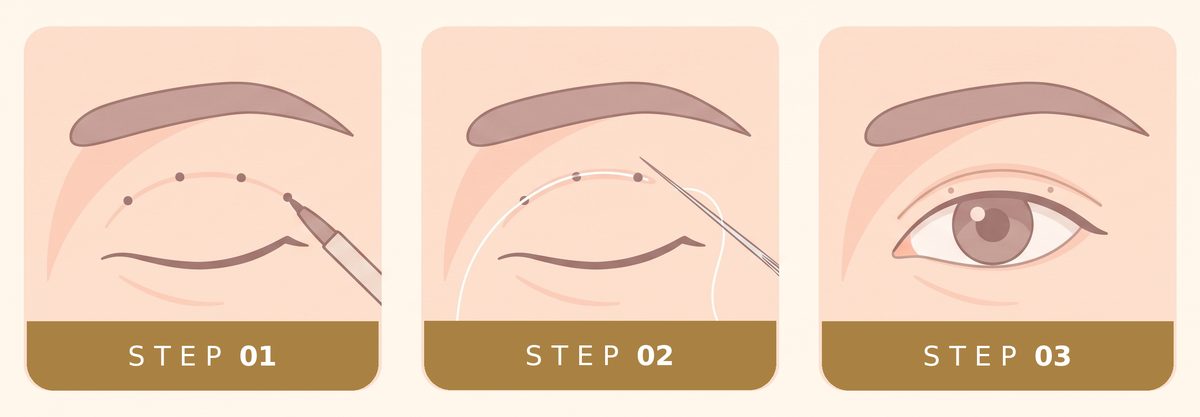
This is a conceptual illustration showing the buried suture procedure. It is not an actual surgical photo or patient image.
What Kind of Eyes Suit the Buried Suture Method?
This surgical method is suitable for eyes that satisfy three criteria simultaneously: thin eyelid skin, minimal fat, and little to no skin sagging. Here is what can be expected in each case:
· Eyes with thin eyelids and minimal fat — Lines tend to hold relatively longer. In a single-institution 2-year follow-up study of 513 patients, thinner eyelids showed significantly less loosening compared to thick, puffy eyelids.
· Eyes without severe eyelid sagging — Skin laxity must be minimal for sutures alone to define and support the crease. Patients with pronounced sagging or excessive skin are typically excluded from buried suture candidates in medical literature.
· Those who want minimal swelling and fast recovery — It is widely reported to involve less swelling and a quicker recovery timeline.
· Those who wish to keep revision options open — Compared to the incisional method, it is reported to be relatively easier to revise or readjust later.
This is a conceptual illustration of before and after buried suture surgery. It is not an actual patient photo, and results vary by individual.
How Does It Differ from the Incisional Method?
The three methods differ in where and how much incision is made to create the crease.
· Buried Suture Method — Creates the crease by tying knots with sutures through minimal micro-openings.
· Full-Incision Method — Creates the crease by making a full incision along the upper eyelid line.
· Partial-Incision Method — For eyes without excessive sagging skin, a small incision is made only in the center, while the rest of the line is secured using buried sutures.
Eyes that may require alternative approaches:
· Thick eyelid skin, abundant fat, or severe sagging — The full-incision or partial-incision method is considered instead of the buried suture method.
· Weak eyelid opening strength (ptosis) — Ptosis correction is considered in conjunction with double eyelid surgery.
If epicanthoplasty or lateral canthoplasty is desired, it can be performed simultaneously alongside double eyelid surgery.
Anatomical conditions vary for every individual.
Potential Side Effects and Postoperative Care
Suitability and healing progress vary based on individual physical conditions, and complications may occur. Representative side effects reported in buried suture literature include:
· The crease may loosen or fade — A primary drawback of the buried suture technique; if it comes undone, revision surgery may be necessary.
· Asymmetry between the left and right eyes may occur or persist.
· Suture knots may show beneath the skin, or small nodules may be palpable.
· Depending on suture fixation positioning, postoperative eyelid drooping (ptosis) can develop.
· If pulling sensations, foreign body sensations, or irritation persist or suddenly emerge years later, suture removal surgery may be required. There is a possibility that sutures cannot be fully retrieved or that the crease may disappear after removal.
Please receive direct guidance from a specialist during consultation regarding other complications and healing timelines.
Seorae Plastic Surgery upholds three core principles for eyelid surgery:
· Primary Surgeon Accountability — Chief Board-Certified Plastic Surgeon Seok-gi Lee manages the entire process from initial consultation to surgery and suture removal.
· Infection Control Standards — Surgical instrument sterilization and treatment area disinfection are thoroughly carried out according to strict protocols.
· Dedicated Recovery Monitoring — Surgery day is not the end of care. Healing and progress are monitored on a regular schedule.
If you have any questions, feel free to contact us at any time. Phone Consultation: 02-547-3351
Frequently Asked Questions
Q. How long does swelling last after double eyelid surgery?
Swelling duration varies depending on surgical technique and individual healing capacity, making it difficult to state a single uniform timeframe for the buried suture method. The partial-incision method spares the medial and lateral lymphatic drainage pathways, helping reduce swelling. A personalized recovery timeline will be discussed during your consultation.
Q. Do I also need ptosis correction (eye shape correction)?
This will be determined after evaluating your eyelid opening muscle strength during the physical examination. If your levator muscle strength is weak, ptosis correction is considered together. The partial-incision approach allows simultaneous correction of blepharoptosis (drooping eyelids) or fat removal.
Q. Do I need to decide between the buried suture and incisional method before visiting?
No, you do not need to decide in advance. The surgical technique is determined after consultation with a plastic surgeon, taking into account muscle strength, skin thickness, and eyelid fat volume.
Q. Does the buried suture method leave visible scars?
Because only tiny micro-punctures are made where the suture passes, minimal visible scarring is considered a major benefit. However, slight indented marks at the puncture sites may occasionally remain.
Q. Can buried suture double eyelids come undone?
Yes, they can loosen. Loosening rates in medical literature range broadly from approximately 1.3% to 16.8%. A 2-year follow-up study of 513 patients showed that loosening was more than twice as common in thick eyelids, with significant variations also linked to suture anchoring techniques.
Consultation & Appointment Information
Phone Consultation / Booking | 02-547-3351Our clinic operates on an appointment-only basis to ensure dedicated medical attention. Please contact us in advance to schedule your visit. |
Clinic Hours | Mon, Tue, Thu, Fri: 10:00 AM – 7:00 PM / Sat: 10:00 AM – 5:00 PMClosed every Wednesday, Sunday, and Public Holidays |
Location | Suite 413, 4th Floor, One Bailey Square, 291 Banpo-daero, Seocho-gu, Seoul |

Directions to Seorae Plastic Surgery Clinic. View on Google Maps
References
· Seorae Plastic Surgery. Eye Surgery Guide. Seorae Plastic Surgery Website. 2026. seoraeps.kr/eye.html (Clinic Website, Not a Study)
· Moon KC, Yoon ES, Lee JM. Modified double-eyelid blepharoplasty using the single-knot continuous buried non-incisional technique. Arch Plast Surg. 2013;40(4):409-413. PMC3724004
· Mizuno T. Treatment of suture-related complications of buried-suture double-eyelid blepharoplasty in Asians. Plast Reconstr Surg Glob Open. 2016;4(8):e839. PMC5010330
· Inoguchi K, Tamura T, Okuma H, et al. The HIROSHIMA Study: a high-volume, institutional, retrospective, observational study of hidden non-incisional suture double eyelid surgery for multivariate analysis of crease loss. Arch Plast Surg. 2026;53(2):135-141. PMC13030923
This article provides general medical information based on clinic website guides and published studies, and does not guarantee specific diagnostic or therapeutic outcomes. Results and recovery timelines may vary by individual, and complications may arise. Please consult a board-certified specialist directly for detailed medical evaluation. This content does not replace professional medical advice.
#BuriedSutureBlepharoplasty #BuriedSutureMethod #NonIncisionalBlepharoplasty #DoubleEyelidSurgery #IncisionalBlepharoplasty #PartialIncision #PtosisCorrection #EyeSurgery #SeochoDoubleEyelid #SeochoPlasticSurgery #BanpoPlasticSurgery #SeoraePlasticSurgery